Leadership
From Infrastructure to Agentic Interfaces
What building through 2024 and 2025 taught us about infrastructure, product discipline, and the shift toward agentic interfaces in 2026.

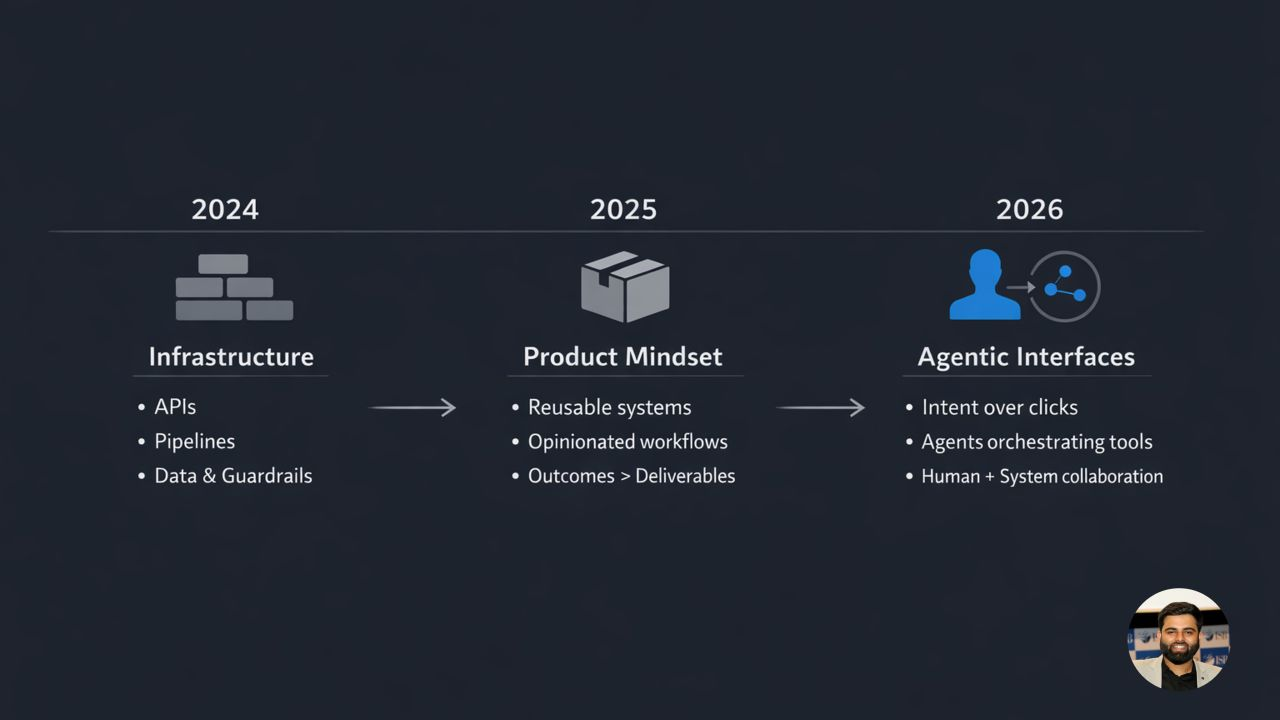
Most people will only see what we ship in 2026 at Assert AI.
Very few will see what almost broke us before that.
This is the part of building that rarely makes it into polished launch posts: the invisible infrastructure, the long rebuilds, the roadmap choices that look slow from the outside, and the lonely feeling of choosing foundations when everyone else seems to be shipping faster.
2024: Invisible Infrastructure
2024 was messy in ways I did not expect.
We spent months building AI and web infrastructure that no one could see. No flashy demos. No quick dopamine hits. Just systems, pipelines, and guardrails.
There were weeks when I kept asking myself:
- Are we overengineering this?
- Should we just ship faster and clean it up later?
- Are fundamentals worth this much silence?
- Will the team stay patient long enough for the compounding effect to show?
Choosing fundamentals over speed felt lonely. At times, it felt risky.
The work itself was not abstract. It meant building the pieces that future products would depend on:
- APIs that could survive more than one customer-specific workflow
- Data pipelines that could normalize messy operational events
- Web foundations that could support product velocity
- Guardrails for security, permissions, and observability
- Reusable primitives instead of one-off delivery shortcuts
At that stage, it would have been easier to build around every immediate request. The problem is that services work can look successful while quietly creating product debt.
The Hidden Cost of "Just Ship It"
"Ship faster and clean it up later" sounds pragmatic. Sometimes it is. But in AI products, the cleanup often touches the foundation: data contracts, evaluation, permission models, observability, and workflow boundaries.
If those pieces are wrong, the product does not merely need refactoring. It needs rethinking.
The hidden cost shows up later as:
- Every new customer requiring a special integration
- Every workflow needing a different data interpretation
- Every demo producing confidence but not repeatability
- Every feature request competing with platform cleanup
- Every incident taking too long to debug
In 2024, the temptation was speed. The lesson was that speed without compounding creates operational drag.
2025: Product Discipline
2025 forced even harder tradeoffs.
Shifting from services to a product mindset meant saying no to things that looked successful on paper:
- Custom work that paid well but did not compound
- Roadmaps that felt exciting but broke foundations
- Being busy instead of being right
- Features that impressed in demos but weakened the platform
We made mistakes.
We built some things too early. We rebuilt some things too late. We underestimated how much product discipline is emotional, not only technical. It is hard to say no to work that feels valuable today so that the system can become more valuable tomorrow.
Product discipline in practice
The shift was not only "build reusable components."
It was learning to ask:
- Does this workflow repeat across customers?
- Does this feature strengthen or weaken the platform?
- Can this become a product primitive?
- What operational cost will this create six months from now?
- Will this decision make future agentic interfaces easier or harder?
What Changed in the Team
The product mindset changed how we discussed engineering work.
We stopped treating every customer request as an isolated delivery problem. We started asking what the request revealed about the platform. We became more opinionated about workflows. We looked for patterns across deployments. We measured value by repeatability, not only completion.
That shift is uncomfortable because it reduces the dopamine of constant delivery. But it creates a healthier kind of velocity: the kind where every product primitive makes the next product easier to build.
2026: Agentic Interfaces
2026 is where everything we built finally converges.
Products are no longer just tools we operate. They are becoming systems that work alongside us.
Agentic interfaces do not feel like a trend to me. They feel like the inevitable outcome of everything we struggled through: strong infrastructure, product discipline, and uncomfortable decisions made early.
View diagram as text
graph LR; Y2024[2024 Infrastructure] --> Y2025[2025 Product Discipline]; Y2025 --> Y2026[2026 Agentic Interfaces]; Y2024 --> APIs[APIs + Pipelines + Guardrails]; Y2025 --> Products[Reusable Systems + Workflows]; Y2026 --> Agents[Intent + Tools + Collaboration]What Agentic Interfaces Change
Traditional software asks users to navigate screens, menus, filters, and forms. Agentic products ask users to express intent, then coordinate the work across systems.
That changes the product surface:
- Navigation becomes conversation plus context.
- Features become tools the system can orchestrate.
- Dashboards become decision surfaces.
- Workflows become policies, approvals, and traces.
- Product quality depends on system reliability, not only UI polish.
This is why the foundation matters. An agentic interface sitting on weak data, weak permissions, or weak workflows is just a more confident way to create confusion.
The New Product Bar
For agentic products, "it works in a demo" is not enough.
The product must answer:
- What does the system know?
- What does it not know?
- Which tools can it use?
- Which actions require approval?
- How does it recover from failure?
- How does the user inspect its reasoning?
- How does the team improve it after launch?
These questions are not edge cases. They are the product.
What I Believe Now
I still do not have all the answers.
But I am sure about this: the next generation of products will not be navigated. They will be partnered with.
That shift changes how we design interfaces, workflows, platforms, and teams. It also raises the bar for reliability, security, and product judgment.
The companies that win will not be the ones with the flashiest agent demo. They will be the ones that understand the operating system underneath the agent: data, permissions, workflows, evaluation, approvals, observability, and trust.
Open Invitation
If this resonates, I would love to talk to builders thinking deeply about agentic products.
I am open to partnerships where long-term thinking beats hype. We are also hiring people who enjoy ambiguity more than certainty.
If you are building for 2026, let's talk.